Greenfield Resource Loop

A community proposal for Botetourt County, Virginia

Don't Waste
the Heat.

The proposed Google data center at Greenfield will produce more than computing power. With intentional planning, its recoverable heat, fiber, and infrastructure can anchor America's first AI Resource Campus — attracting new industries, supporting research, and creating hundreds of lasting jobs around the servers themselves.

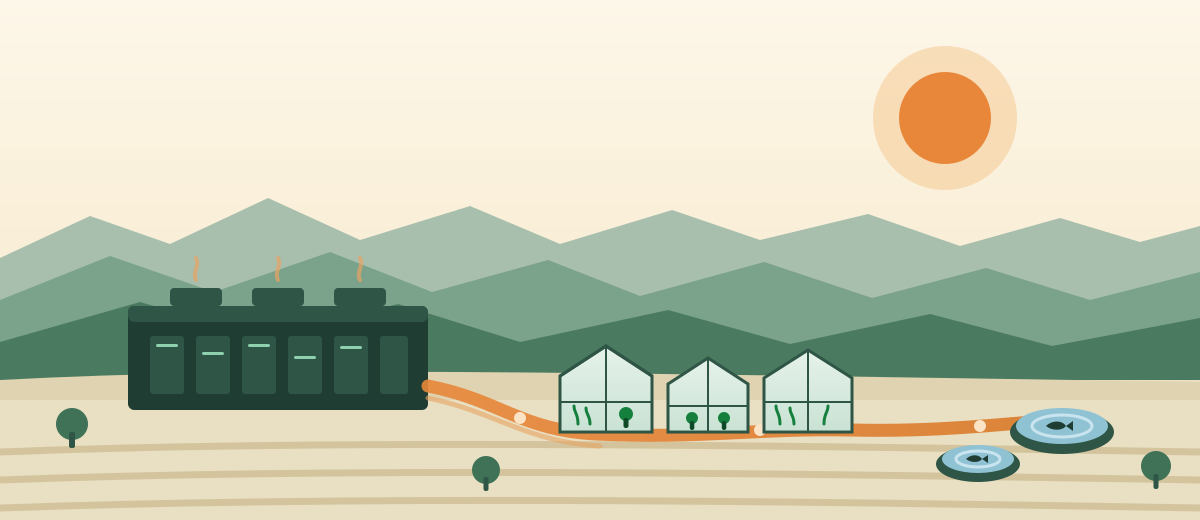
Illustration of the Greenfield valley: a data center sending recovered heat to greenhouses and aquaculture tanks beneath the Blue Ridge mountains

This proposal is not an attempt to stop or delay the Google campus. It is an economic development strategy designed to maximize the long-term value the project creates for the region.

From data to development

One decision separates a data center from an economic engine.

Instead of

"Google builds a data center."

Create

"Google anchors America's first AI Resource Campus."

The premise is simple. Data centers require major investments in utilities and infrastructure. They produce recoverable low-grade heat. They attract fiber, power, and engineering talent. Those resources should be intentionally leveraged to attract additional businesses.

The objective is to transform Greenfield into a nationally recognized model for next-generation industrial development — without changing Google's business.

Power the cloud. Grow the community.

How the resource loop works

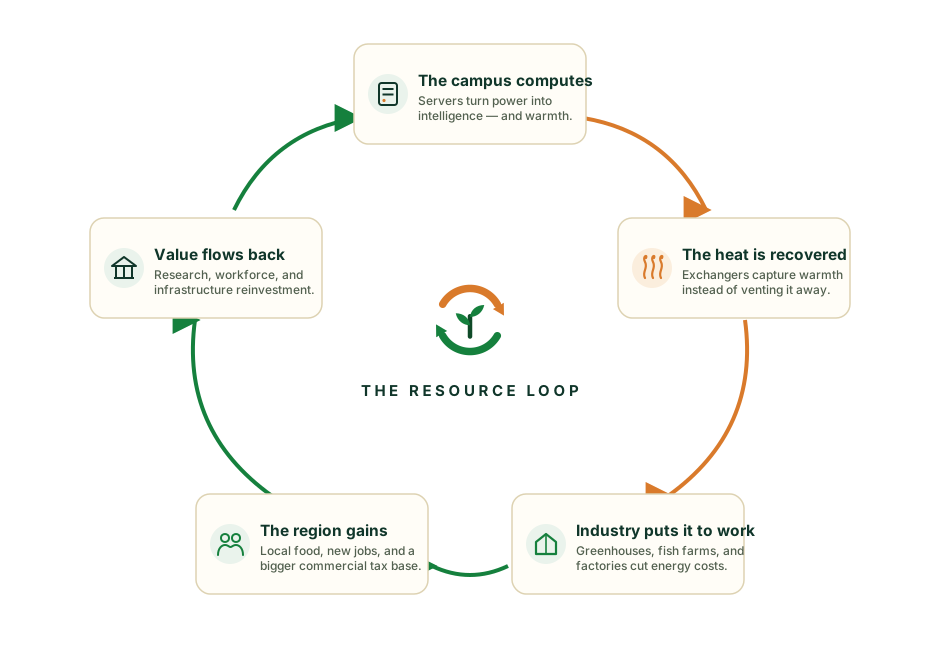
Every hour of computing releases warmth that is normally vented into the sky. Recovered and piped next door, that same warmth becomes one of the cheapest inputs a greenhouse or a fish farm can buy — and the value it creates flows back into the region.

Diagram of the resource loop: the campus computes, heat is recovered, industry puts it to work, the region gains, and value flows back to the campus

Guiding principles

Everyone stays in their lane. Everyone gains.

Compute more. Waste less.

Four phases, one campus

01

Heat-Ready Campus

Design the campus so recoverable waste heat can be exported in the future: recovery headers, heat exchangers, pump stations, thermal metering, utility easements, and reserved expansion space.

$10–30M additional investment — a small percentage of a multi-billion-dollar campus.

02

Innovation Resource District

Rather than selling surrounding parcels, Google retains ownership and leases land to complementary industries — curating compatible tenants while earning recurring lease revenue on 30–99 year ground leases.

Tenants get existing utilities, fiber, reliable power, and potential access to recoverable heat.

03

Water Innovation Center

Smart metering, AI leak detection, reclaimed water, irrigation optimization, watershed analytics, drought forecasting, and infrastructure monitoring.

Potential partners: Google, Western Virginia Water Authority, Botetourt County, Virginia Tech, and private engineering firms.

04

Thermal Utility District

Long-term expansion carries recovered warmth beyond the campus: schools, recreation centers, public pools, government facilities, mixed-use developments, and future commercial users.

Digital infrastructure becomes community infrastructure.
The Innovation Resource District

What grows next to a data center

Agriculture

Commercial greenhouses, hydroponics, aquaponics, seedling production, plant nurseries, vertical farming, and mushroom cultivation — all hungry for steady, low-cost warmth.

Flagship opportunity

Aquaculture

A modern land-based facility raising tilapia, barramundi, catfish, freshwater prawns, ornamental fish, or hatchery stock. Waste heat directly reduces the industry's largest operating expense: keeping water at a stable temperature. Coupled with greenhouses, fish production feeds aquaponic crop production.

Google simply leases land and provides infrastructure access where practical. Private companies own and operate the facilities.

Food Processing

Produce packaging, food dehydration, controlled storage, and agricultural logistics — closing the distance between harvest and shelf.

Research

Virginia Tech, community colleges, agricultural technology companies, water technology research, and AI sustainability research.

Advanced Manufacturing

Industries that need warm process water or low-grade heat gain a structural cost advantage by locating inside the loop.

The 10-year outlook

What intentional planning is worth

These values are conceptual planning targets drawn from the initiative's concept study — illustrative, not guaranteed forecasts.

600–1,100 potential permanent jobs
$8–20M illustrative additional annual tax revenue
$200–550M combined new investment, all sources
600–1,000 temporary construction jobs

Where the jobs come from

  • Google operations~150+
  • Innovation District tenants300–700
  • Support businesses150–300
  • Construction (temporary)600–1,000

Mature-state impact also includes tens of millions in payroll, additional business activity, expanded property values, and an increased commercial tax base.

Digital infrastructure. Community infrastructure.

Who benefits

Google

  • Sustainability leadership
  • A national demonstration project
  • Stronger community relations
  • A replicable development model
  • Long-term lease revenue

Government

  • A diversified economy
  • Infrastructure modernization
  • Workforce development
  • Research partnerships
  • Higher commercial investment

Citizens

  • New employment
  • Educational opportunities
  • Local food production
  • A stronger regional economy
  • Improved infrastructure

Immediate next steps

Six moves that start the loop

  1. Commission an independent engineering feasibility study.
  2. Quantify the recoverable heat.
  3. Evaluate potential thermal customers.
  4. Identify available land for an Innovation Resource District.
  5. Engage Google, Botetourt County, the Western Virginia Water Authority, Virginia Tech, and private investors.
  6. Develop a detailed engineering, financial, and governance roadmap.

Add your name

Ask for the heat-ready campus — before the concrete is poured.

To the Botetourt County Board of Supervisors and the Greenfield project team: we, the undersigned, welcome the data center investment — and we ask that the campus be planned as a Heat-Ready Campus from day one, so its recoverable warmth, fiber, and infrastructure can grow new industries, research, and lasting jobs for our region.

Your name and email are used only for this initiative. They are never sold or shared beyond delivering the petition to the officials named above.

The Greenfield campus represents more than a data center. Planned intentionally, it becomes an ecosystem where digital infrastructure attracts new industries, supports research, modernizes utilities, creates jobs, and generates long-term economic value far beyond the servers themselves.

The objective is not to change Google's business. It is to build a regional economy around the infrastructure Google already intends to create.
Add your name

Organizations and potential partners can start the conversation here.